


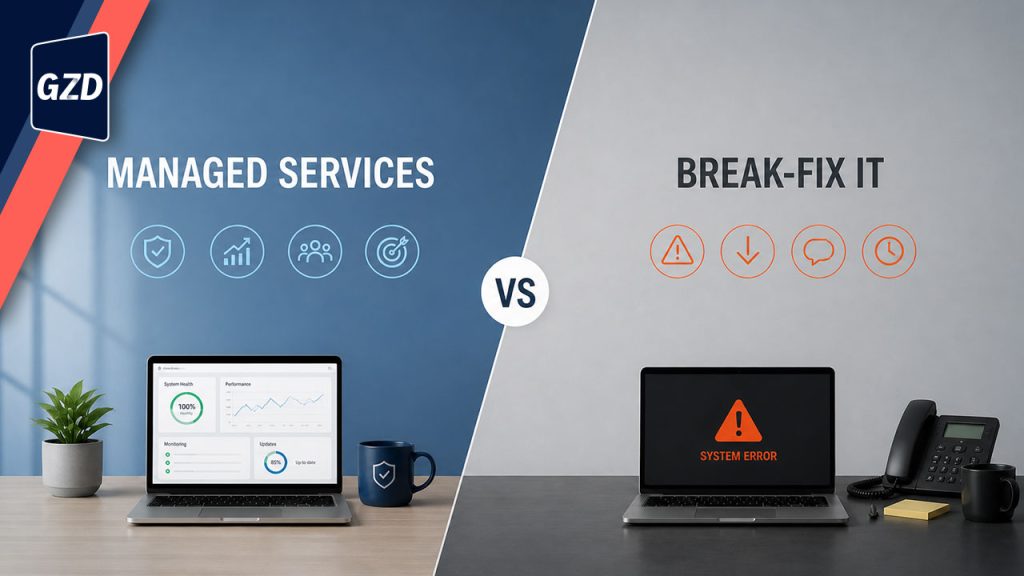
Managed Services vs Break-fix IT: Which is Really Better for Your Business?
If your IT only gets attention when something breaks, you’re not alone.
Many South African business owners still rely on break-fix IT support, calling someone when email goes down, a server fails, or a laptop stops working. On the surface, it feels simple and often cheaper.
But here’s the honest question most business owners eventually ask:
Is break-fix IT actually costing me more in downtime, disruption, and risk than I realise?
This article gives a clear, no-nonsense comparison between break-fix IT support and working with a Managed Services Provider (MSP), so you can decide what truly makes sense for your business.
No jargon. No scare tactics. Just straight answers.
What Is Break-fix IT Support?
Break-fix IT follows a straightforward model:
- Something breaks
- You call for help
- It gets fixed
- You receive a bill
There’s no proactive monitoring, no preventative maintenance, and no long‑term planning. IT support only happens after something has already gone wrong.
Why Some Businesses Still Choose Break‑Fix
- No monthly commitment
- You only pay when there’s a problem
- It feels cost-effective for very small or simple environments
For businesses with minimal reliance on technology, break-fix can work.
For most modern businesses, technology is now critical, and that’s where break-fix starts to fall short.
What Is a Managed Services Provider (MSP)?
A Managed Services Provider (MSP) takes a proactive approach to IT.
Instead of waiting for systems to fail, your environment is:
- Continuously monitored
- Regularly updated and maintained
- Secured against modern cyber threats
- Supported for a predictable monthly fee
It’s the difference between responding to emergencies and preventing them altogether.
The Real Difference – Reactive vs Proactive IT
This is where most business owners have their “aha” moment.
Break-fix IT (Reactive)
- Problems are addressed after disruption
- Downtime impacts staff productivity and customers
- Costs are unpredictable
- Security issues often go unnoticed
- Your IT provider gets paid when things break
Managed IT Services (Proactive)
- Issues are identified before users notice
- Downtime is significantly reduced
- Costs are predictable and budget‑friendly
- Security is actively managed
- Your IT partner is incentivised to keep systems running smoothly
Managed Services vs Break-fix IT: Side-by-Side Comparison
| Area | Break-fix IT Support | Managed IT Services (MSP) |
| Support approach | Reactive – fixes after failure | Proactive – problems prevented |
| Cost structure | Per incident or hourly | Fixed monthly fee |
| Downtime impact | Longer and disruptive | Reduced through monitoring |
| Monitoring | None | 24/7 monitoring |
| Maintenance & updates | On request only | Ongoing and automatic |
| Cybersecurity | Reactive and limited | Built-in protection |
| Business continuity | Backups often unchecked | Backups tested and monitored |
| Accountability | Transactional | Long-term IT partner |
| Strategic guidance | None | Ongoing business-aligned advice |
| Predictability | Uncertain costs | Stable and predictable |
For most businesses, the decision comes down to predictability versus uncertainty, both in cost and system performance.
Is Break-fix IT Really Cheaper?
Break‑fix often looks cheaper because there’s no monthly fee, but that’s rarely the full picture.
What’s typically overlooked:
- Staff unable to work during downtime
- Lost productivity and missed deadlines
- Emergency call‑out rates
- Repeat issues caused by temporary fixes
- Failures that preventative maintenance could have avoided
Managed IT services replace surprise costs with predictable monthly spend, while reducing business disruption.
Why Cybersecurity Changes the Conversation
Cyber threats don’t wait for something to break.
Without proactive monitoring:
- Malware can sit unnoticed for months
- Ransomware spreads quietly
- Patches and updates are missed
- Backups fail when they’re needed most
A proper Managed Services Provider includes security as standard, not as an optional add‑on.
When Does Break-fix Still Make Sense?
Break-fix may still be suitable if:
- You have fewer than five users
- Your systems are very basic
- Downtime won’t affect revenue or clients
- You’re comfortable accepting disruption
Once your business relies on cloud systems, email, line-of-business software, or data security, break-fix becomes a risk.
Why Most Growing South African Businesses Choose Managed Services
Businesses don’t move to managed IT because they want “better IT”.
They move because they want:
- Fewer interruptions
- Predictable costs
- Improved security
- Clear accountability
- Peace of mind
A good MSP supports the business, not just the technology.
Frequently Asked Questions – Managed Services vs Break-fix IT
➡️ Is break-fix IT bad for small businesses?
Break‑fix isn’t bad by default, but it becomes limiting as businesses grow and rely more on technology.
➡️ Why are managed IT services more expensive than break-fix?
Managed services include monitoring, maintenance, security, and support, often reducing emergency repairs and downtime over time.
➡️ What is the biggest risk of staying on break-fix IT?
Unplanned downtime and security incidents that are only discovered after disruption.
➡️ Do managed IT services include cybersecurity?
Yes. Proper managed services include security, patching, backups, and monitoring.
➡️ Is managed IT only for large companies?
No. Managed services are particularly valuable for SMEs that don’t want to hire internal IT staff.