


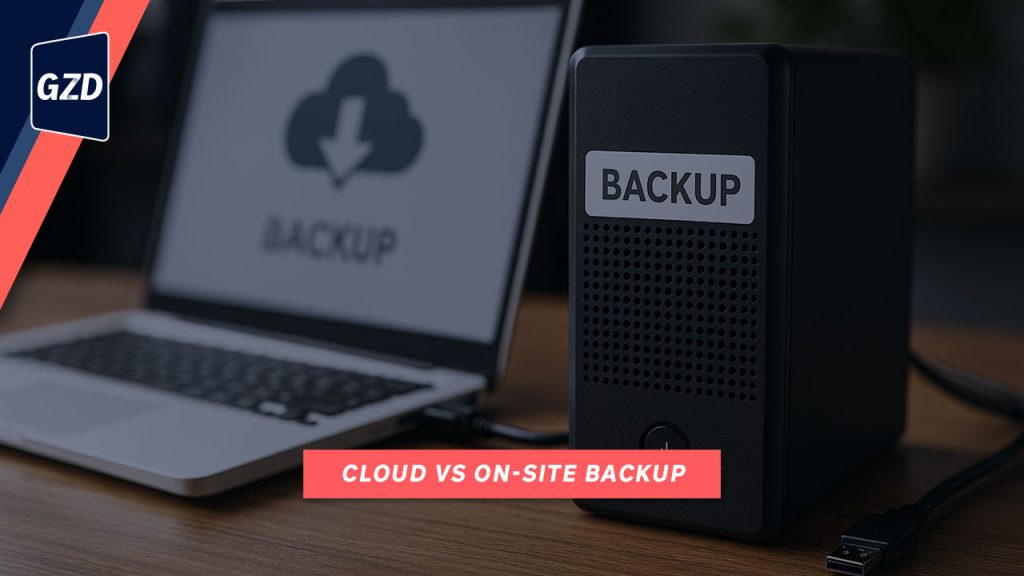
Cloud vs On-Site Backup: What’s Best for Your Business?
In today’s digital-first business environment, data is both your most valuable asset and your biggest risk.
Many South African businesses face a critical question: should you rely on cloud backup, on-site backup, or a combination of both?
The answer could determine how quickly your business recovers from downtime, cyberattacks, or unexpected disasters.
This article explores the key differences between cloud and on-site backups, along with expert recommendations to help you choose the right solution for your business.
What Is Cloud Backup?
Cloud backup (also known as online backup) stores your data securely in remote data centers managed by third-party providers.
Key Benefits:
- Off-site protection (safe from fires, theft, natural disasters)
- Automatic backups and scalability
- Access data from anywhere
- Reduced need for physical infrastructure
What Is On-Site Backup?
On-site backup stores data locally; typically, on servers, NAS devices, or external drives within your business premises.
Key Benefits:
- Fast backup and restore speeds
- Full control over data
- No dependency on internet bandwidth
- One-time investment (no recurring cloud fees)
Cloud Backup vs. On-Site Backup: Key Differences
| Feature | Cloud Backup | On-Site Backup |
| Location | Remote data centers | Physical office |
| Accessibility | Anywhere, anytime | Only on location |
| Security Risk | Cyber risks | Physical risks (fire, theft) |
| Speed | Depends on internet | Very fast |
| Scalability | Easy to scale | Hardware dependent |
| Cost | Subscription-based | Upfront cost |
Finding the Right Backup Strategy for Your Organisation
Q. “Should I choose cloud backup or on-site backup?”
A. There is no one-size-fits-all answer, but the best practice is a hybrid approach.
Why?
- On-site backup gives you speed and control
- Cloud backup gives you disaster recovery and redundancy
Together, they form the 3-2-1 backup rule:
- 3 copies of data
- 2 different storage types
- 1 off-site copy
Real-Life Case Study: When Backup Strategy Makes or Breaks a Business
The Scenario
A small accounting firm in Durban relied solely on on-site backup via a local server. One weekend, a power surge damaged their infrastructure, corrupting both their primary data and backup system.
The Outcome
- Lost 7 days of financial records
- Faced compliance risks
- Spent weeks rebuilding data manually
What Could Have Prevented This?
A simple cloud backup integration would have allowed:
- Instant recovery from off-site storage
- Minimal data loss
- Faster business continuity
Is Cloud Backup Safe?
This is one of the most common concerns.
The Truth:
Cloud backup is extremely secure when properly configured, featuring:
- End-to-end encryption
- Multi-factor authentication
- Redundant storage systems
However, risks still exist:
- Misconfiguration
- Weak access controls
- Ransomware propagation
How to Mitigates Cloud Backup Risks
An experienced Managed Service Provider (MSP) like GZD plays a critical role in securing and optimising backup strategies.
1. Implement Hybrid Backup Solutions
- Combine cloud + on-site backups
- Follow industry best practices like the 3-2-1 rule
2. Advanced Security Protocols
- Encryption (at rest and in transit)
- Zero-trust access controls
- Continuous monitoring for suspicious activity
3. Ransomware Protection & Recovery
- Immutable backups (cannot be altered or deleted)
- Fast restore capabilities
- Backup isolation to prevent malware spread
4. Automated Backup Management
- Scheduled backups (no human error)
- Real-time alerts for failures
- Compliance-ready reporting
5. Disaster Recovery Planning (DRaaS)
- Build full disaster recovery plans
- Test backup restoration regularly
- Ensure minimal downtime during incidents
6. Compliance & Data Governance
For regulated industries, they ensure:
- POPIA compliance (South Africa)
- Secure data retention policies
- Audit-ready documentation
Protect your business before disaster strikes.
Contact GZD today to assess your current backup strategy and implement a secure, compliant, and resilient solution tailored to your business.